
Up close, it becomes a restless ocean of clouds
For centuries, Jupiter appeared to Earthbound observers as a bright wandering star. Through small telescopes, it revealed faint bands and four large moons. But it was only when spacecraft began traveling into the outer solar system that Jupiter transformed from a distant blur into a dynamic, turbulent world of storms, lightning, and swirling clouds.
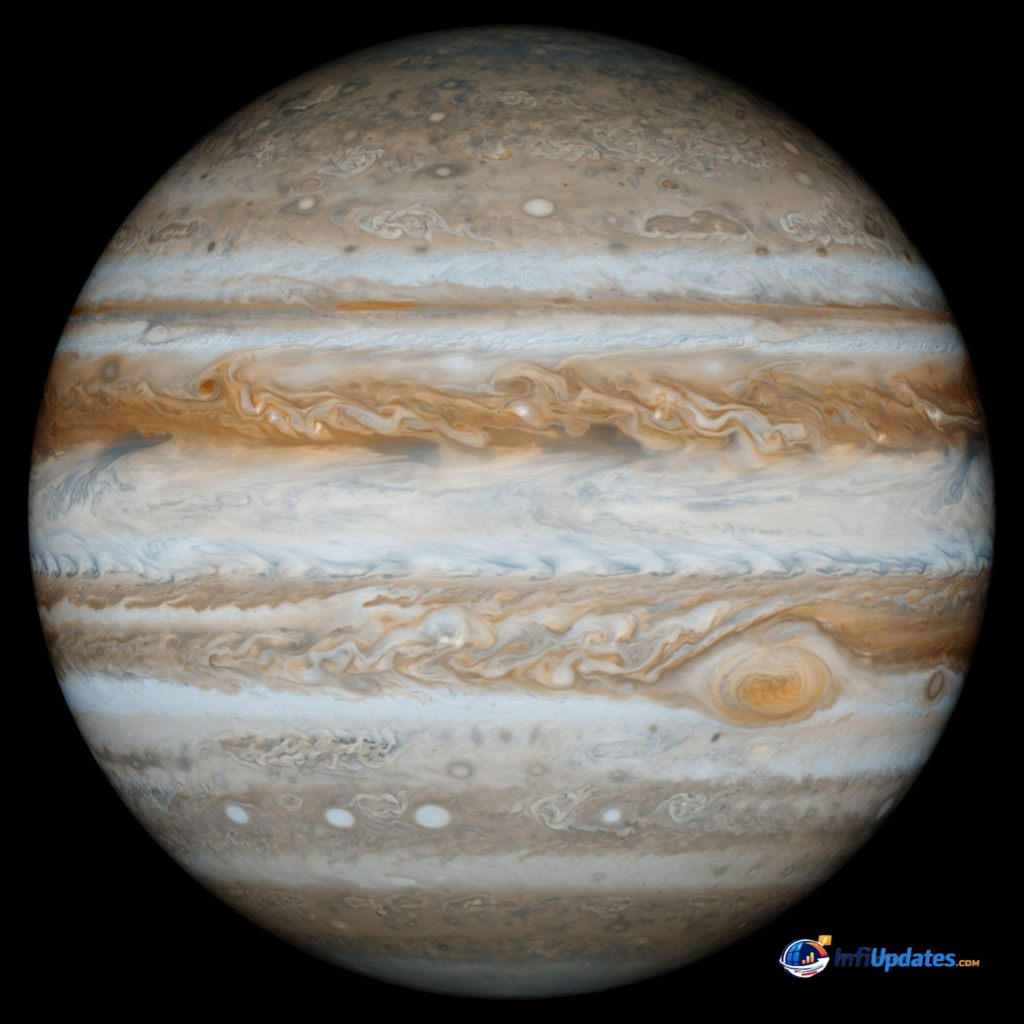
NASA spacecraft have photographed Jupiter from both near and far, offering two very different — and equally breathtaking — perspectives. From millions of miles away, Jupiter looks like a majestic striped marble suspended in darkness. Up close, it becomes a restless ocean of clouds, where storms larger than Earth churn in dramatic detail.
Seeing Jupiter From Afar
Images taken from great distances show Jupiter in its full glory — a massive gas giant with alternating light and dark bands wrapping around its equator. These bands are caused by powerful jet streams moving in opposite directions, creating a layered appearance across the planet’s atmosphere.
From afar, the most recognizable feature is the Great Red Spot — a gigantic storm that has raged for more than 300 years. In wide-angle photographs, it appears as a reddish oval embedded within the southern hemisphere’s cloud bands. Though it looks calm in still images, the storm is a violent vortex large enough to swallow Earth whole.
Space telescopes and flyby missions have captured these full-disk portraits, helping scientists track changes in color, storm size, and atmospheric patterns over time. Subtle shifts in hue reveal chemical activity in the upper atmosphere, while the movement of cloud belts shows how energy circulates through the planet’s thick gaseous envelope.
Up Close: A World of Turbulence
When spacecraft approach Jupiter, the view becomes dramatically different. Instead of a smooth striped globe, close-up images reveal intricate textures — swirling cyclones, twisting filaments, and chaotic cloud formations shaped by immense internal heat and rapid rotation.
NASA’s Juno spacecraft, currently orbiting Jupiter, has provided some of the most detailed close-range images ever taken. Its camera peers down on the planet’s poles, regions never before seen in such clarity. Instead of simple stripes, the poles are crowded with clusters of cyclones arranged in geometric patterns. These storms interact like dancers locked in a gravitational choreography.
Near the cloud tops, the scale of Jupiter’s atmosphere becomes astonishing. Waves ripple through ammonia clouds. Lightning flashes illuminate towering storm systems. Shadows stretch across layered clouds, revealing vertical structure and depth. The closer the camera gets, the more Jupiter resembles a living canvas painted in creams, oranges, browns, and blues..
The Great Red Spot in Detail
From a distance, the Great Red Spot looks like a single oval blemish. But close-up photography reveals its complexity. The storm’s edges are ragged and turbulent, with high-speed winds tearing at its perimeter. Within the vortex, bands of lighter and darker clouds spiral inward, showing the storm’s powerful rotation.
Recent images show that the Great Red Spot is gradually shrinking compared to historical measurements, though it remains immense. Its color also shifts over time, sometimes appearing deeper red and at other times fading toward orange. These changes provide clues about chemical reactions occurring in Jupiter’s upper atmosphere.
Moons in the Background
Photographs taken from farther away often capture Jupiter alongside its largest moons — Io, Europa, Ganymede, and Callisto. These moons appear as tiny points of light or small disks casting shadows across the planet’s cloud tops.
The shadows create dramatic scenes: perfect black circles sliding across swirling white clouds. Such images not only look striking but also help scientists refine orbital calculations and study interactions between Jupiter’s magnetic field and its moons.
Why Both Perspectives Matter
Distant images provide context. They show the planet as a whole system — how its belts align, how storms migrate, and how its appearance evolves over months and years. These broad views allow scientists to track long-term climate patterns and understand the planet’s atmospheric circulation.
Close-up images, on the other hand, reveal detail. They expose turbulence at small scales, capture lightning events, and show how individual storms behave. Without these intimate views, Jupiter would remain a simplified striped sphere rather than the complex, dynamic world it truly is.
Together, near and far photography tells a complete story. It allows scientists to connect large-scale atmospheric motion with small-scale storm physics. It also transforms public understanding, turning abstract astronomical data into vivid imagery that inspires curiosity and wonder.
A Planet of Extremes
Jupiter is the largest planet in our solar system, more than twice as massive as all the other planets combined. Its powerful gravity, intense radiation belts, and enormous magnetic field make it both fascinating and challenging to explore.
Yet spacecraft continue to return remarkable photographs that deepen our knowledge. Each new image reveals something unexpected — a new storm forming, a band shifting position, or a cyclone merging with another. Jupiter is not static; it is constantly evolving.
The Art of Planetary Photography
Beyond their scientific value, NASA’s Jupiter images possess undeniable artistic beauty. Swirling cloud tops resemble abstract paintings. Color-enhanced versions highlight contrasts invisible to the human eye, revealing subtle details in atmospheric composition.
Citizen scientists often help process raw spacecraft images, adjusting contrast and color balance to create visually stunning results. These collaborations blur the line between science and art, showing that planetary exploration can be both analytical and creative.
Looking Ahead
Future missions and continued observations promise even more extraordinary images. As cameras improve and spacecraft venture closer, our view of Jupiter will become sharper and more detailed.
From distant portraits that showcase its grandeur to close encounters that expose its turbulent heart, NASA’s photographs have forever changed how we see the solar system’s largest planet. Jupiter is no longer just a bright dot in the night sky — it is a complex, storm-filled giant whose beauty grows with every image sent back to Earth.