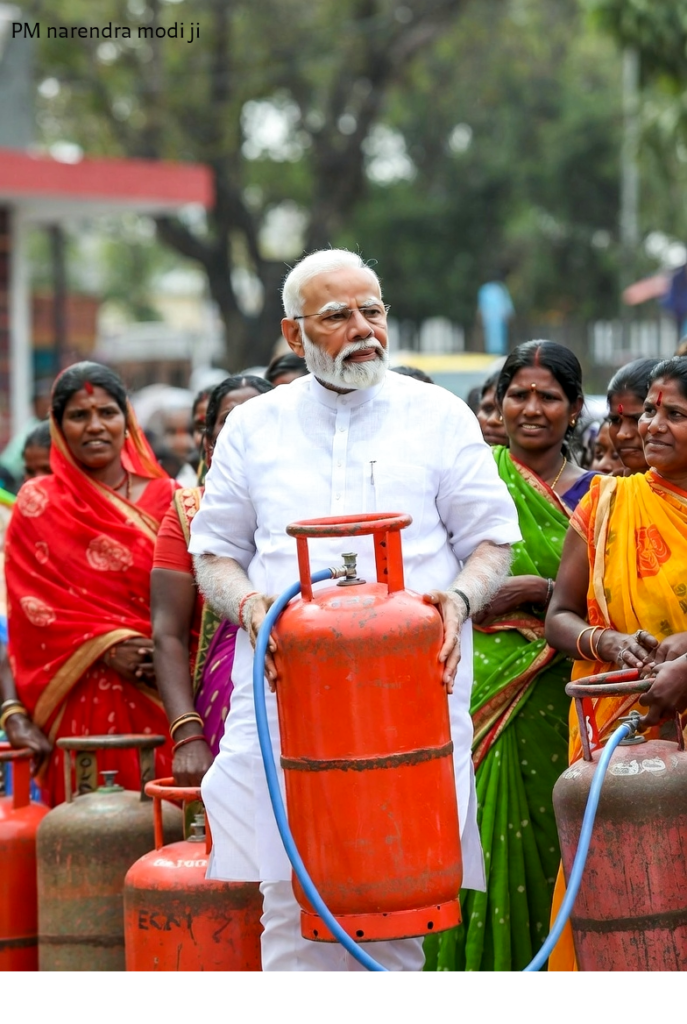
The government was planning an unusual solution
In a surprising development that has sparked intense discussion across political and public circles, Prime Minister Narendra Modi has reportedly introduced a new initiative called the “Nala Gas Scheme.” The announcement comes at a time when concerns over LPG availability and rising energy costs have been affecting households in several parts of the country. According to early reports and political commentary circulating online, the scheme is being framed as a response to fears of a potential cooking gas shortage.
The claim surrounding the “Nala Gas Scheme” began spreading rapidly on social media platforms and messaging groups, where users shared posts suggesting that the government was planning an unusual solution to ensure that LPG supplies do not run out. The posts state that the Prime Minister initiated the scheme specifically for his followers or supporters as part of a broader attempt to manage a potential gas crisis. However, as the story began gaining traction, questions emerged about the authenticity and context of the announcement.
The Background: LPG Concerns and Energy Pressure
- India’s dependence on LPG for household cooking has increased significantly over the past decade. Government programs such as the Pradhan Mantri Ujjwala Yojana helped millions of low-income families gain access to LPG connections, replacing traditional fuels like firewood and kerosene. While this transition improved health and environmental conditions, it also increased demand for LPG across the country.
- In recent months, fluctuations in global energy markets and geopolitical tensions have caused uncertainty in fuel supply chains worldwide. Whenever such uncertainty arises, discussions about energy security quickly become a major political issue. This environment has made any rumor or news related to gas supply spread extremely quickly online.
- The so-called “Nala Gas Scheme” narrative appears to have emerged within this atmosphere of heightened concern about energy availability. Supporters and critics alike have debated the idea, with many asking whether it represents an actual policy proposal, a misunderstanding, or simply a piece of satire circulating on social media.
What the Viral Claims Say
Posts about the alleged scheme describe it as an initiative intended to ensure that cooking gas remains available even during severe supply disruptions. The name itself — “Nala Gas Scheme” — has caught attention because of its unusual wording. In many discussions, the term has been used humorously or sarcastically, leading observers to suspect that the narrative may be part of political satire rather than a genuine government policy.
According to the viral posts, the scheme would supposedly provide an alternative method of accessing gas in case LPG cylinders become scarce. However, no official government notification, press release, or statement from the Prime Minister’s Office has confirmed the existence of such a program.
Government Silence Raises Questions
As the claim continued to circulate, journalists and fact-checking organizations began looking for official confirmation. Typically, any nationwide scheme introduced by the central government is accompanied by detailed documentation, guidelines, and announcements through official channels. These include press briefings, ministry notifications, and coverage by major national news outlets.
In this case, however, there has been no official communication from the government confirming that the “Nala Gas Scheme” exists. The Ministry of Petroleum and Natural Gas has not issued any statement regarding such a program, and the Prime Minister’s Office has also remained silent on the matter.
Because of this lack of official confirmation, many analysts believe the story may be a piece of political satire or misinformation that has been misinterpreted as real news.
Social Media Amplification
The rapid spread of the claim demonstrates how quickly information — accurate or otherwise — can circulate in the digital age. Within hours, posts referencing the “Nala Gas Scheme” began appearing on platforms such as X (formerly Twitter), Facebook, and WhatsApp. Some users shared the claim as breaking news, while others posted it as a joke or meme.
This mixture of humor, sarcasm, and serious commentary often makes it difficult for readers to distinguish between verified news and satire. When political figures are involved, such posts tend to gain even more attention, fueling debates and arguments among supporters and critics.
Experts say that this pattern has become common in modern political communication. A satirical comment or edited image can quickly be taken out of context and interpreted as factual information, especially when shared widely across social networks.
Importance of Verification
The situation surrounding the “Nala Gas Scheme” highlights the importance of verifying information before accepting it as true. In India, several independent fact-checking organizations work to identify misleading or false claims circulating online. Their role has become increasingly important as the volume of digital information continues to grow.
Journalists emphasize that official government policies are always announced through recognized channels, including ministry websites, press conferences, and national media outlets. If a major initiative affecting millions of households were truly launched, it would likely be accompanied by detailed explanations of how the scheme works, who is eligible, and how citizens can apply.
Until such confirmation appears, reports about the scheme should be treated with caution.
Political Reactions and Public Debate
Even without confirmation, the rumor has already triggered political commentary. Some critics have used the claim to mock government policies, while supporters argue that the story is clearly a piece of satire being misrepresented as news. Others see the situation as an example of how misinformation can distort public discussion.
Political analysts say that such viral narratives often reveal the deep polarization present in contemporary politics. When a claim involves a prominent leader like Prime Minister Narendra Modi, it can quickly become a topic of heated debate.