

They solve puzzles, escape enclosures
Octopuses and squids have long fascinated scientists with their remarkable intelligence. They solve puzzles, escape enclosures, camouflage instantly, and even display behaviors that suggest curiosity and problem-solving ability. But what makes these soft-bodied marine animals so smart?
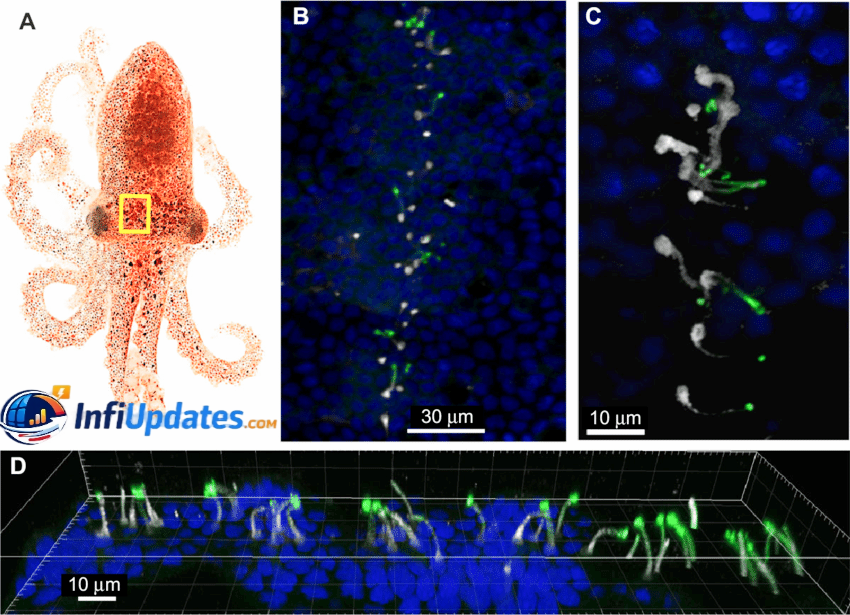
Recent genetic research suggests that a rare biological feature — a kind of “genetic oddity” — may play a key role in shaping their advanced nervous systems.
The Curious Intelligence of Cephalopods
Octopuses and squids belong to a group of marine animals called cephalopods. Unlike most invertebrates, they possess complex nervous systems and large brains relative to their body size.
Octopuses, for example:
- Can open jars to access food
- Use tools in controlled experiments
- Learn through observation
- Navigate mazes
Their intelligence rivals that of some vertebrates, yet they evolved entirely separately from mammals and birds. This makes their cognitive abilities especially intriguing from an evolutionary standpoint.
What Is the Genetic Oddity?
Scientists have discovered that cephalopods, including octopuses and squids, exhibit unusually high levels of RNA editing.
Normally, genetic information flows like this:
DNA → RNA → Protein
In most animals, once RNA is transcribed from DNA, it remains largely unchanged before guiding protein production. However, in cephalopods, RNA molecules are frequently edited after transcription.
This means:
- The same gene can produce multiple protein variations
- Neurons can adapt protein function more flexibly
- The nervous system gains dynamic regulation
This level of RNA editing is rare among animals and appears especially concentrated in neural tissue.
Why RNA Editing Matters
Proteins are the building blocks of cells and determine how neurons communicate. By editing RNA, cephalopods can fine-tune the proteins that shape brain function.
Potential benefits include:
- Enhanced neural plasticity
- Faster adaptation to environmental changes
- Greater behavioral flexibility
In simple terms, this genetic flexibility may allow octopuses and squids to respond quickly to new challenges — a trait closely linked to intelligence.
A Trade-Off in Evolution
Interestingly, high levels of RNA editing may come at a cost.
Because RNA editing requires genetic stability in certain DNA regions, it can limit the rate at which those genes evolve. In other words, cephalopods may sacrifice some long-term genetic flexibility in exchange for short-term neural adaptability.
This evolutionary trade-off suggests that intelligence can arise through multiple biological pathways.
Distributed Intelligence
Another unique feature of octopuses is their decentralized nervous system. A large portion of their neurons are located in their arms rather than centralized solely in the brain.
This allows:
- Independent arm movement
- Complex manipulation
- Rapid environmental interaction
Combined with RNA editing, this neural distribution creates a highly responsive and adaptable organism.
Comparing Cephalopods to Humans
Humans rely primarily on DNA-level genetic variation and complex brain structures to support intelligence. Cephalopods appear to use a different strategy — enhancing flexibility at the RNA level.
This discovery broadens our understanding of how intelligence can evolve. It shows that advanced cognition is not exclusive to vertebrates and may emerge under different evolutionary pressures.
Implications for Science
Studying cephalopod genetics may help scientists:
- Understand neural adaptability
- Explore mechanisms of learning and memory
- Investigate neurological resilience
- Develop insights into brain disorders
These marine animals provide a powerful model for alternative evolutionary solutions to complex behavior.
The Mystery Continues
While RNA editing appears to contribute to cephalopod intelligence, it is unlikely to be the sole factor. Brain structure, environmental demands, and behavioral ecology also shape cognitive ability.
Octopuses and squids evolved in competitive marine environments, where camouflage, quick decision-making, and problem-solving offered survival advantages.
Their intelligence reflects millions of years of adaptation beneath the ocean’s surface.
The idea that a genetic oddity may give octopuses and squids their smarts reminds us that evolution is endlessly creative. Intelligence is not confined to one blueprint.
Through extensive RNA editing and unique neural organization, cephalopods demonstrate that complex cognition can emerge in unexpected ways.
As research continues, these remarkable sea creatures may help us better understand not only marine life but the fundamental biology of intelligence itself.