Opposition and Government Clash Over Energy Security as Global Conflict Disrupts Fuel Supplies
New Delhi, March 13, 2026:
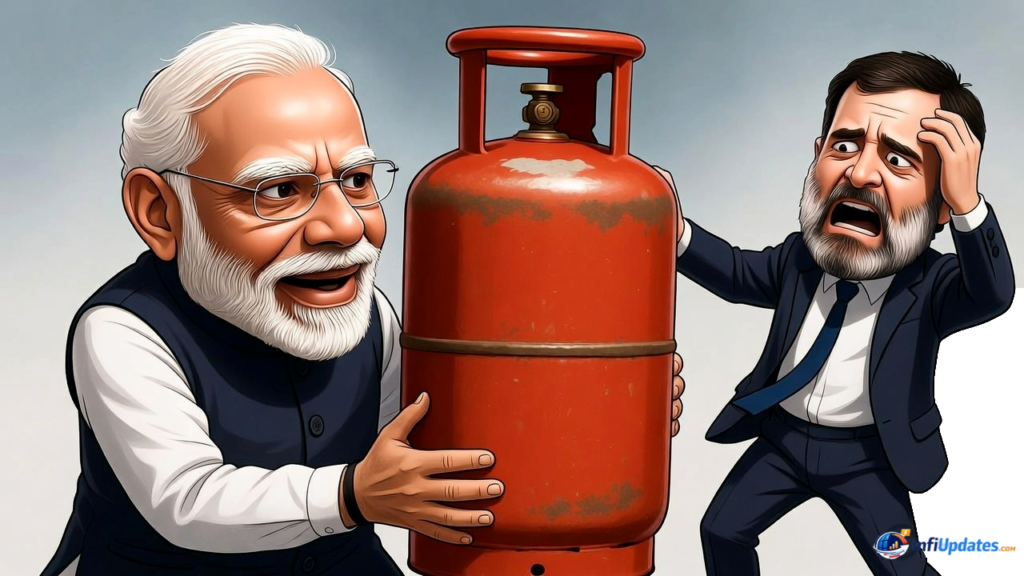
Rising tensions in the Middle East have begun to ripple across global energy markets, and India is now confronting delays in liquefied petroleum gas (LPG) imports that have triggered a heated political confrontation. What began as concern over supply disruptions has quickly evolved into a fierce debate in Parliament, with the opposition accusing the government of compromising the country’s energy security and the ruling side dismissing the criticism as political opportunism.
The controversy intensified this week when Congress leader Rahul Gandhi launched a sharp attack on the Narendra Modi government, arguing that flawed foreign policy decisions have left India vulnerable to global shocks in fuel supply. The remarks, delivered both at a public rally in Lucknow and later in the Lok Sabha, have sparked widespread debate across the political spectrum and on social media.
Heavy Dependence on Middle East Imports Raises Alarm
India is among the world’s largest consumers of LPG and relies heavily on imports to meet domestic demand. Nearly 80 percent of the country’s LPG supply comes from the Middle East, making it particularly sensitive to geopolitical instability in that region.
The ongoing conflict involving the United States, Israel, and Iran has created serious disruptions in maritime trade routes, particularly around the Strait of Hormuz, one of the most critical energy corridors in the world. A significant portion of global oil and gas shipments pass through this narrow waterway connecting the Persian Gulf to international markets.
With tensions escalating in the region, several tanker operators have either rerouted their vessels or delayed shipments due to security concerns. These logistical challenges have led to delays in LPG deliveries to countries that rely heavily on Middle Eastern energy exports, including India.
As international oil and gas prices climb in response to the uncertainty, households and small businesses across India have begun expressing concern about the possibility of cooking gas shortages.
Rahul Gandhi Warns of a Growing Energy Crisis
- Addressing a large crowd in Lucknow earlier this week, Rahul Gandhi warned that the LPG issue could be the beginning of a broader energy crisis.
- According to Gandhi, India’s dependence on imported energy combined with geopolitical tensions has exposed weaknesses in the country’s strategic planning.
- “All fuel is going to be a problem because essentially our energy security has been compromised,” he said. “Flawed foreign policy has created this situation.”
- He argued that India must reassess its diplomatic and energy strategies to protect citizens from economic shocks caused by international conflicts.
- Gandhi repeated similar concerns inside Parliament on March 12, claiming that India had allowed external pressures—particularly from the United States—to influence its oil purchasing decisions, including the conditions under which India can buy discounted Russian crude.
Personal Allegations Target Oil Minister Hardeep Singh Puri
The political debate took a more controversial turn when Gandhi directed criticism toward Petroleum and Natural Gas Minister Hardeep Singh Puri.
During the parliamentary discussion, Gandhi referenced past professional interactions between Puri and the late American financier Jeffrey Epstein, who was convicted in 2008 for sex offences involving minors.
Gandhi alleged that publicly available documents indicated Puri had met Epstein several times between 2014 and 2017 and exchanged emails during that period. According to Gandhi, these interactions occurred while Puri was participating in international forums discussing economic and digital policy issues.
The remarks immediately triggered strong reactions from members of the ruling party.
Minister Rejects Allegations as Political Distraction
Hardeep Singh Puri quickly dismissed the accusations, describing them as baseless and politically motivated.
In media interviews following the parliamentary exchange, Puri said that he had met Epstein only a limited number of times in professional settings and usually in the presence of other participants at international events.
“These were networking meetings focused on promoting India’s economic opportunities,” he explained.
Puri also emphasized that he had no knowledge of Epstein’s criminal activities during those encounters and pointed out that the interactions took place years before he joined the Union Cabinet in 2017.
Calling the accusations “complete buffoonery,” the minister accused the opposition of attempting to distract from substantive policy discussions.
Soros Funding Claim Triggers Chaos in Lok Sabha
The situation escalated further when Gandhi introduced another allegation in Parliament concerning funding linked to Puri’s daughter.
According to Gandhi, a document suggested that Himanee Puri’s firm, Realm Partners LLC, had reportedly received significant financial backing—estimated at around ₹2,400 crore—from entities connected to billionaire investor George Soros and an associate of Epstein.
As Gandhi attempted to elaborate on the claim, his microphone was reportedly switched off by Lok Sabha Speaker Om Birla, who asked him to remain focused on the scheduled topic of discussion.
The incident sparked immediate uproar inside the chamber. Members of the ruling party raised slogans, and the House descended into chaos before being adjourned for nearly half an hour.
Social Media Debate Intensifies
Following the parliamentary clash, the controversy quickly spread across social media platforms.
Rahul Gandhi posted a series of messages describing the sequence of events in the Lok Sabha. In his account, he claimed his microphone had been turned off repeatedly when he attempted to raise questions about energy policy and the alleged financial connections he mentioned.
Supporters of the opposition amplified his claims, arguing that the government was attempting to silence criticism.
Meanwhile, supporters of the ruling Bharatiya Janata Party accused the Congress leader of spreading misinformation and attempting to create panic about fuel shortages for political advantage.
Government Reassures Citizens About LPG Supply
Amid the political dispute, the Ministry of Petroleum and Natural Gas moved quickly to calm public concerns.
Officials stated that India currently has sufficient LPG stocks to meet domestic demand for the next 10 to 12 days and that supply chains remain operational despite international disruptions.
According to the ministry, the recent surge in LPG bookings—reported to have increased by about 36 percent in some regions—was largely driven by panic purchasing rather than actual supply shortages.
Authorities urged consumers not to engage in unnecessary bulk bookings, stressing that distribution networks remain stable.
To further stabilize the situation, the government has also increased production at domestic refineries and encouraged expanded use of piped natural gas in urban areas.
Russian Oil Imports Offer Temporary Cushion
Government officials also highlighted India’s diversified energy strategy as a buffer against global shocks.
One key factor has been the continued purchase of discounted Russian crude oil. Despite Western sanctions related to the Ukraine conflict, the United States granted temporary waivers allowing India to continue importing Russian energy supplies.
These waivers, initially issued for 30 days and later extended, have enabled Indian refiners to access millions of barrels of crude oil at reduced prices, helping offset supply constraints caused by disruptions in the Middle East.
Officials maintain that India’s crude import sources are spread across multiple regions, reducing dependence on any single supplier.
Experts Warn of Long-Term Risks
Despite the government’s reassurances, energy analysts caution that prolonged instability in the Middle East could create serious challenges for India and other energy-importing countries.
If shipping through the Strait of Hormuz remains restricted for an extended period, global fuel prices could rise sharply. Higher prices would eventually translate into increased domestic costs for LPG and other fuels.
Small businesses such as roadside restaurants, food vendors, and dhabas—many of which rely heavily on LPG cylinders—could be particularly vulnerable to price increases.
Political Battle Intensifies
The Congress party has demanded that Minister Hardeep Singh Puri resign and called for a formal investigation into the allegations raised in Parliament.
The ruling BJP has strongly rejected these demands, accusing the opposition of attempting to manufacture a crisis and divert attention from broader economic and political issues.
As political tensions escalate, the debate has become a major focal point in national discourse.
Energy Security Under Global Pressure
With geopolitical tensions continuing in the Middle East and global energy markets remaining volatile, India’s dependence on imported fuel has once again come into focus.
While the government insists that supply disruptions are temporary and manageable, critics argue that the situation highlights the need for stronger long-term energy security strategies.
Ultimately, the course of events will depend largely on how the international conflict evolves. If tensions ease and shipping routes stabilize, supply pressures could quickly diminish. However, if the crisis deepens, India—like many energy-importing nations—may face a difficult balancing act between economic stability and geopolitical realities.